Thursday, December 20, 2012

Police Precinct reviewed by The Dice Tower!

Veteran reviewer Tom Vasel was more than pleased with the game, and called it "a great game" and “maybe THE best cooperative game of the year, if not the best one I’ve ever played!”.

What more could a game designer want for his first published board game?  :-)


Click above to go to the video review

Click above to go to the Boardgamegeek site for Police Precinct

Saturday, December 8, 2012

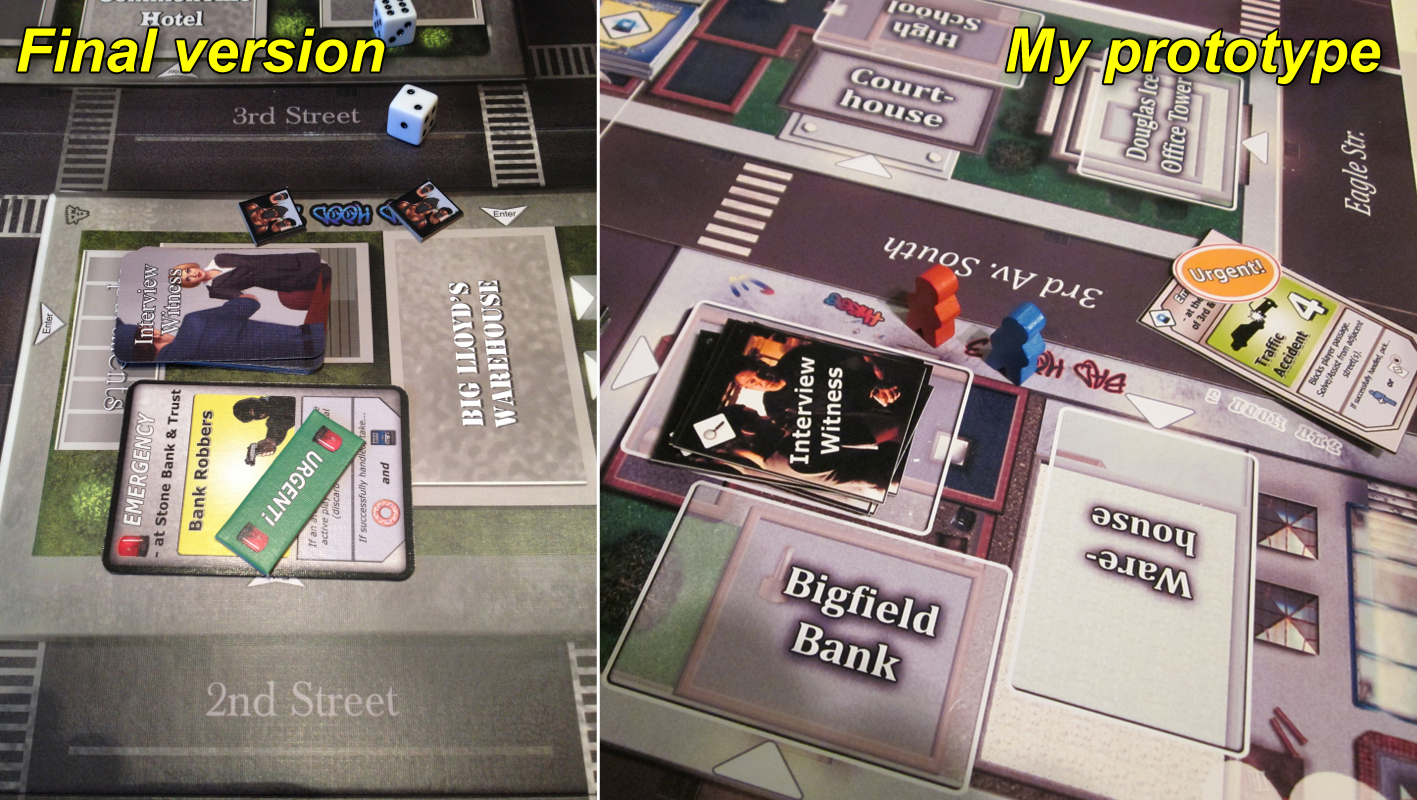
Police Precinct produced!

Quite some time since I wrote on this blog, but now is the time, I guess.

I have been busy with a large number of board game designs. Some were canned, lots are in the making (at various stages) and one is actually being published: Police Precinct, a semi-cooperative board game about solving a hideous murder crime in a modern age American city. Players move around the city in their police cars to collect crime evidence while at the same time trying to keep control of street crime and other police emergencies.


The game is being published by Common Man Games and should be available in US stores at the beginning of 2013 while the rest of the world will have to wait a few extra months.

See more about the game at the publisher's website, www.commonman.com , or at Boardgamegeek: http://boardgamegeek.com/boardgame/118536/police-precinct .


In addition to these exciting news, I have also decided to upload the games Beer Con and Into The Fire to Boardgamegeek, as web-published, print-and-play, games.


Beer Con (short for Convention) is a simple dice game, somewhat inspired by Zombie Dice: Players take turns rolling three dice, trying to get lots of "beer glasses" while avoiding "queue" and "drunk" symbols. Three "drunk" symbols will mean no beer for the player this turn. If the player stops in time, he/she may take as many beer labels from the table, as the sum of beer glasses rolled.

The winner is the player who collects the most types of beer (labels) at the Beer Con.

The game was meant to be simple fun for the annual Xmas beer tasting event in my family, and it turned out pretty good (although 12 players was stretching the maximum number of player a bit!).

On a side note, thinking up and creating the beer labels (score point tokens, for gamers) was certainly fun:


Into The Fire (earlier known simply as Firefighters) is my first really good release candidate, and a big, international publisher was very close to publish it when disaster struck: Flash Point: Fire Rescue, a very similar game (but simpler), was released. It was IMHO the worst thing that happened in 2011 - obviously I had to go to my publisher and tell them the "bad" news. This was really hard, as we all worked really hard to make my firefighting game a reality. Of course, Flash Point: Fire Rescue is doing great now...

However, I refuse to bury my beloved game in silence - the game is too great for that. Instead, I am releasing it on Boardgamegeek, hoping that someone will find it worth the time to download, put together and play.

Into The Fire is different from Flash Point: Fire Rescue in these key areas:

- It's a "dungeon crawl" inspired game, focusing more on exploration and adventure, than tactics
- It's more realistic, as fires spread from the heat source and not just randomly
- Players will meet real fire hazards, like backdrafts and flash-overs, collapsing floors, igniting fire gasses and walls of smoke
- It features many types of objects to interact with, as well as a varied environment in each of the campaign scenarios included

Saturday, March 22, 2008

Ghost Hunters

Ghost Hunters is a board game where one part of the players controls some haunting ghosts while the rest of the players control the ghost hunters. The goal for the ghosts is to scare all the residents out of their homes - the ghost hunters' goal is to banish the ghosts before this happens.

Each turn the ghosts draws new haunts which are cards they can play on the rooms in the houses to scare the people residing inside. Some people are easier to scare with some haunts, than others. If, for example, one person is afraid of darkness, then he/she will flee several rooms towards the exit if the lights go out.

The ghost hunters, in turn, can draw and play cards to dispell the haunts. They can also try to figure out which types of ghosts are haunting the houses, as not all ghosts can use all types of haunts. If the ghost hunters figure out which ghosts are present, they can try to banish them with the right cards. Lastly, the ghost hunters can also spend cards to try to calm down the residents so they won't flee from their homes.


The game is loosely inspired by the computer game GHOST MASTER for PC.

Friday, March 21, 2008

Space Stations

Space Stations is a fairly simple sci-fi themed board game I designed gameplay and graphics and tested on my trusty gaming friends this month. I borrowed pieces from RISK and STAR WARS RISK to fill out the blanks (= robots and power tokens). It plays best with 4-5 player, I believe.


Each player controls a circular space station manned by three types of robots: AllroundBots, GunBots and PowerBots. The players take turn producing power and shooting at each other's space station, hoping to blast the other stations to pieces and win the game.

One unique feature is the rotating element: In order to maintain artificial gravity, the space stations continously turn. Therefore, each player turn starts with the player rotating his/her space station 90 degrees clockwise, hiding half of the station in safety "at the back" (facing himself/herself) and exposing the front half of the space station.

Only one of the two front sections of a space station can shoot. When shooting, a small amount of energy is drained from the section with the firing gun, but even more energy is drained from the space station hit. You can easily shoot at your neighbours, but it will take more energy to hit opponents farther away (= not sitting next to you around the table).

Your robots can produce power, fire guns, move around the station, repair segments or build more robots.

Sometimes you earn bonus cards which can be played to e.g. boost your attack. This is the only luck factor in the game (no dice throwing, hidden tokens or anything like that).

The game has almost no luck - to win you must keep a cool head, figure out what your opponents are up to and then plan ahead at least a few turns. For example: What part of your space station will face your neighbour to your left in the next turn? Will he/she be able to retaliate if you spend all your power to attack his/her space station? Is it worth it? E.g. can you earn some points, a card or take out some robots during the attack? Will you be vulnerable to attack from your neighbour to your right if you attack now? Should you move a robot away from your guns to produce an additional robot, or is it too expensive? And so forth...

Saturday, June 23, 2007

Designing and building games

Since I spend most of my time designing games (it's my job and lifetime passion), I thought I would join the blog-mania and share my thoughts on the subject. Mostly because I think up so many designs (both computer- and board games) and I would like to write them down somewhere (=here!) for later reference, inspiration, show-and-tell... or just for lack of better things to do.


If you for some reason read this and would like to comment on it, please feel free to do so. If not, well, then I'll keep on writing anyway for my own sake :-)